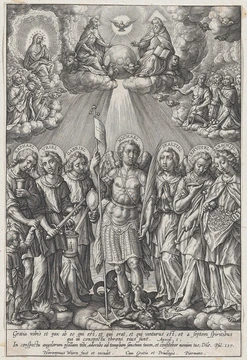
Angel of Portugal
The only recognized national angel, guardian of Portugal.

Fanny Schertzer · CC BY 3.0
The Angel of Portugal, also known as the Guardian Angel of Portugal, the Holy Guardian Angel of Portugal, the Custodian Angel, or the Angel of Peace, is celebrated as the guardian angel of the nation of Portugal. It is the only 'national angel' recognized as such, with its feast day observed on 10 June.
- field
- Guardian angel of Portugal
- nationality
- Portugal
- known_for
- Only recognized national angel; associated with the 1916 apparitions to the Fátima children
- feast_day
- 10 June
- also_known_as
- Angel of Peace, Custodian Angel, Holy Guardian Angel of Portugal
Lore & Background
The east wall of the chapel at the Batalha Monastery, construction of which commenced in 1386, had an altar dedicated to the Guardian Angel of Portugal. In 1504, by request of King Manuel I of Portugal, Pope Julius II created the feast of the Custodian Angel of the Kingdom. The cult declined considerably after the 17th century and was officially restored in 1952, its feast day inserted into the Portuguese liturgical calendar by Pius XII.
Lúcia dos Santos and her cousins Francisco and Jacinta Marto, the three children who claimed in 1917 to have seen Marian apparitions now titled Our Lady of Fátima, also reported that this angel had visited them three times beforehand in 1916, calling himself the 'Angel of Peace'. They said he taught them the first two Fátima Prayers, as well as penance, before giving them Holy Communion. The Angel of Portugal has at times been identified as Saint Michael.
Reader's Guide
The Angel of Portugal holds a unique place in religious and national identity as the only officially recognized national angel. Its cult, established in the early 16th century by papal decree, reflects the intertwining of faith and nationhood in Portuguese history. The decline of the cult after the 17th century and its restoration in the 20th century illustrate shifting devotional practices. The angel's reported appearances in 1916 to the Fátima children, who later witnessed the famous Marian apparitions, link it to one of the most significant modern Catholic events. The children claimed the angel taught them prayers and penance, and gave them Holy Communion. The occasional identification of this angel with Saint Michael adds a layer of theological ambiguity. The feast day on 10 June serves as a continuing reminder of Portugal's celestial patron.
Did You Know?
- The Angel of Portugal is the only 'national angel' recognized as such.
- Its feast day, 10 June, was inserted into the Portuguese liturgical calendar by Pius XII in 1952.
- The three Fátima children reported that the angel visited them three times in 1916, calling himself the 'Angel of Peace'.
- The Angel of Portugal has at times been identified as Saint Michael.
Biblical Roles of Angels
Angels in Christian scripture serve multiple functions that extend well beyond simple message-bearing. They act as counsellors and guides across both the Old and New Testaments. Psalm 91:11-12 specifically assigns them the task of protecting human beings. In the Gospels, Jesus himself references angelic presence in two distinct ways. In Matthew 18:10, he cautions against looking down on children, noting that their heavenly angels constantly behold the Father's face, implying a personal, ongoing connection between each child and a divine attendant. In Luke 20:34-36, angels are used as a model for the resurrected state: those deemed worthy of the age to come will share the angels' freedom from marriage and from death. Together, these passages frame angels as guardians, perpetual intercessors, and living exemplars of what humanity is called to become after the resurrection.
Ancient and Patristic Reflections
The conviction that each person is accompanied by a guardian angel did not originate with Christianity. Greek writers such as Menander and Plutarch, as well as Neo-Platonic philosophers like Plotinus, already held this belief, a fact preserved in Eusebius's Preparatio Evangelica. Early Christian fathers built on this foundation in distinct ways. Ignatius of Antioch, in his Letter to the Trallians, offered a classification of angelic ranks that anticipated the later system of Pseudo-Dionysius. Clement of Rome urged his congregation to join the angels in praising God, while Clement of Alexandria described angels as breathing into human thought and reasoning, instilling strength and sharper perception in the heart. Evagrius Ponticus framed angels as companions and behavioral models. Augustine of Hippo added a dynamic dimension: he saw the angels themselves as witnessing something new as God's creation unfolded, and he emphasized that the good angels continually steer humanity toward God, the true source of happiness, while encouraging worship.
The Pseudo-Dionysian Hierarchy
The most influential angelic classification in Christian theology emerged around the turn of the sixth century in a work titled De Coelesti Hierarchia, attributed to Pseudo-Dionysius the Areopagite. The author claimed to be a prominent figure converted by the Apostle Paul, a claim that lent the text extraordinary authority. The system divides the angelic realm into three spheres, each containing three orders, producing a nine-tiered structure that would shape centuries of theological writing. The work's influence was amplified by its pseudonym; had the author written under his true name, its reception might have been far more modest. That changed in the early sixteenth century when Erasmus publicly raised doubts about the text's antiquity, exposing the authorship question to wider scrutiny. Despite this, the hierarchy's structural logic of three nested triads remained a dominant framework for understanding the celestial order in Western Christian thought.
Divergent Angelologies Across Christian Traditions
Different Christian communities have developed markedly distinct angelologies. The Catholic Catechism declares the existence of non-corporeal spiritual beings called angels a truth of faith, grounded in both Scripture and the unanimity of Tradition, and asserts that Christ stands at the center of the angelic world, which was created through and for Him. Swedenborgian theology takes a radically different path: every angel originated as a human being, all children who die eventually become angels, and angelic names like Michael or Gabriel denote functions rather than individual persons. Angels dwell in innumerable societies, each serving according to the usefulness cultivated in earthly life. The Latter Day Saint movement similarly ties angels to humanity, teaching that no angels minister to earth who do not belong to it or have belonged to it. In this tradition, Adam is the archangel Michael, Gabriel lived as Noah, and Moroni was a fifth-century prophet-warrior in pre-Columbian America. Joseph Smith's own account of his first vision describes a figure in a robe of extraordinary whiteness, standing in the air, whose countenance resembled lightning.
Gallery



Frequently Asked Questions
Who is the Angel of Portugal?
The Angel of Portugal is the guardian angel specifically assigned to protect and watch over the nation of Portugal. It goes by several names, including the Holy Guardian Angel of Portugal, the Custodian Angel, and the Angel of Peace.
What is the Angel of Portugal's role or function?
Its primary role is to serve as the spiritual guardian and protector of Portugal as a whole nation, rather than of a single individual or locality. In this capacity it is sometimes called the Custodian Angel, emphasizing its duty of oversight and care over the country.
When is the Angel of Portugal's feast day?
The feast day honoring the Angel of Portugal is observed on 10 June each year. On that date, Portuguese Catholics set aside the day to give thanks for the angel's ongoing guardianship of the nation.
How is the Angel of Portugal connected to the Fátima apparitions?
The angel is traditionally associated with the 1916 apparitions witnessed by the three shepherd children at Fátima, where it is said to have appeared to them before the Marian visions. This link ties the angel's identity closely to one of the most well-known modern Marian events in Catholic history.
What makes the Angel of Portugal unique among all angels in Christian tradition?
It holds the distinction of being the only angel explicitly recognized as a national guardian angel, with its patronage attached to an entire country rather than a person, city, or cause. No other angel in Catholic tradition carries the same formal title of guardian to a sovereign nation.
More in Angels in Christianity 1-24
Spotted an error? Know more?
This is a living reference — every entry is fact-audited, and reader corrections feed straight into our audit queue. Suggest an edit · See this site's audit record