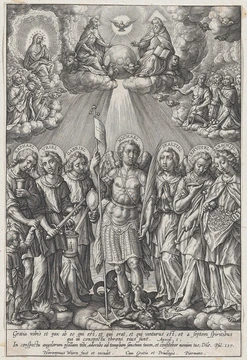
Ezekiel's cherub in Eden
Biblical figure identified with the King of Tyre or his guardian.

In Ezekiel 28:13–14, a figure called the cherub appears in Eden. Some Bible versions, like the New International Version, equate this cherub with the King of Tyre, though the NIV does not name a specific king. Other versions, such as the New Revised Standard Version, interpret the cherub as the king’s protector rather than the king himself.
The prophet Ezekiel refers to Eden in two major passages, but only one of them (28:11–19) describes the Tyrian king using the image of the cherub in Eden; the other (Ezekiel 31) speaks of Assyria, not Eden. Tyre was known for its temple complex dedicated to Melkart, though there is no widely established evidence for a famous garden enclosure specifically associated with that temple.
The figure has drawn significant theological attention. Early Christian writer Tertullian, in *Against Marcion* 2:10, connected the cherub to Satan’s fall, an interpretation many later Christians adopted. Other theories have emerged: one holds that the prophet depicted the cherub in a state of original perfection, ended by sin and banishment from the “mountain of God.” Another suggests Eden was a metaphor for the splendor of a real place—in this case, Tyre—and that its human king represented Satan, who appears as a serpent in Genesis 3.
- source
- Ezekiel 28:13–14
- associated figure
- King of Tyre (possibly Ithobaal III)
- reign
- contemporary with Ezekiel at the final fall of Jerusalem (587/586 BCE)
- field
- Biblical exegesis
- known for
- Interpretation as either the King of Tyre or his guardian; linked to the fall of Satan by Tertullian
Lore & Background
Ezekiel cites Eden in two extensive passages, but only one (28:11-19) portrays the king of Tyre in terms of the cherub in Eden; the other (Ezekiel 31) refers to Assyria. The city is famed for the temple complex of Melkart, though no widely established evidence supports a renowned garden enclosure there. Tertullian in Against Marcion 2:10 linked the reference to the fall of Satan, which has been followed by many Christians since.
Reader's Guide
The theological interpretation of Ezekiel's cherub in Eden has been subject to much theorizing. One recognized that the prophet depicted such cherub within a state of primordial perfection, which was terminated by sin and consequent exile from the 'mountain of God.' Another theory posited that Eden was a simile for the portrayal of the splendor of a given geographical area, which in this case is Tyre, and that its human king represented Satan, who was a snake in the garden in Genesis 3. The figure thus serves as a nexus for debates about literal versus allegorical readings of scripture, and about the identity of the cherub as either a human ruler or a supernatural being. Its legacy is shaped by Tertullian's influential interpretation, which has persisted in Christian tradition.
Did You Know?
- The cherub in Eden is mentioned in Ezekiel 28:13–14.
- Some Bible versions, like the New International Version, identify the cherub with the King of Tyre, but do not name Ithobaal III.
- Tertullian in Against Marcion 2:10 linked the cherub to the fall of Satan.
- One theory posits that Eden was a simile for the splendor of Tyre.
The Identity Question
The figure at the heart of Ezekiel 28:13–14 has generated a persistent interpretive divide among translators and scholars. The New International Version, among others, reads the cherub as a direct identification with the King of Tyre—specifically Ithobaal III, whose reign (591–573 BC) is recorded in Josephus's list of Tyrian kings and places him as a reigning contemporary of Ezekiel during the first fall of Jerusalem. In this reading, the prophet's Edenic language is a veiled political critique aimed squarely at a living monarch. Other translations, such as the New Revised Standard Version, take a markedly different path, understanding the cherub not as the king himself but as his guardian—a protective figure stationed at the throne. This distinction matters enormously: one interpretation makes the passage a prophetic indictment of a specific historical ruler, while the other frames it as a description of a divine or semi-divine attendant. The ambiguity has persisted across centuries of translation work, and no single reading has achieved universal consensus.
The Tyrian Garden and Melkart's Temple
Ezekiel's Edenic imagery does not appear in a vacuum. The prophet invokes the garden of Eden in two extensive passages, and the one relevant here—Ezekiel 28:11–19—casts the king of Tyre in the language of that primordial paradise. The choice of setting is no accident. Tyre was renowned throughout the ancient Near East for its temple complex dedicated to Melkart, the city's chief deity, and that complex included a celebrated garden enclosure. This physical reality of a walled, cultivated sacred space within a major Phoenician port city gave the prophet a concrete backdrop against which to build his Edenic simile. By layering the lush, well-tended imagery of a royal garden over the figure of the Tyrian king, Ezekiel draws a deliberate parallel between the cultivated splendor of Melkart's precinct and the idealized perfection of the biblical garden. The garden thus functions not merely as poetic decoration but as a culturally specific reference point that Tyrian and broader Phoenician audiences would have immediately recognized, grounding the prophet's theological argument in the tangible geography of the city he is addressing.
Tertullian and the Satanic Reading
The single most consequential interpretive move in the history of this passage came from Tertullian. In his work Against Marcion (book 2, chapter 10), the early Church Father explicitly linked the cherub's fall in Ezekiel 28 to the fall of Satan. This identification proved extraordinarily durable; it has been followed by a vast number of Christians across the centuries and effectively became the default reading in much of Western theological tradition. Yet the passage's theological interpretation has remained a fertile ground for ongoing theorizing. Tertullian's connection did not close the question so much as open a new one: if the cherub is Satan, what exactly is the nature of the fall described? What does the 'mountain of God' signify in this context? How does the Edenic setting in Ezekiel relate to the garden narrative in Genesis? These and related questions have generated layers of commentary and debate, making the passage one of the most theoretically contested in the prophetic books. Tertullian's single move in Against Marcion thus set in motion a tradition of exegesis that continues to evolve.
Two Competing Theological Frameworks
Scholars and theologians have developed at least two major frameworks for understanding the cherub's narrative arc in Ezekiel 28. The first reading holds that the prophet deliberately depicted the cherub within a state of primordial perfection—a condition of wholeness and divine favor that was subsequently broken by sin, resulting in exile from the 'mountain of God.' In this view, the Edenic language is literal theological description: the cherub existed in an original, uncorrupted state before a moral transgression severed that relationship. The second theory takes a different approach, arguing that Eden functions not as a literal setting but as a simile for the splendor of a specific geographical area—namely Tyre. Under this reading, the human king of Tyre is understood as representing Satan, drawing a deliberate parallel to the serpent in the Genesis 3 garden narrative. The two frameworks are not entirely incompatible, but they emphasize different aspects: one foregrounds the moral and theological drama of fall and exile, while the other foregrounds the rhetorical and geographical specificity of the prophet's target. Both have found adherents, and the tension between them continues to shape how the passage is read.
Gallery
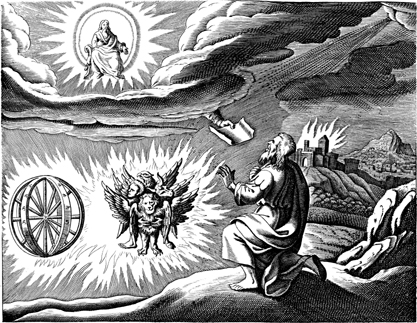
Frequently Asked Questions
Who is Ezekiel's cherub in Eden?
The cherub in Eden is a figure described in Ezekiel 28:13–14, whom most scholars identify either as the King of Tyre (possibly Ithobaal III, ruling during the fall of Jerusalem in 587/586 BCE) or as that king's divine guardian. The text itself does not name a specific angel by title, leaving the identification open to interpretation.
What role does Ezekiel's cherub in Eden play?
The passage portrays the cherub as an anointed protective figure stationed in the Garden of Eden, adorned with precious stones and walking among firestones. Its function is that of a guardian rather than a warrior or messenger, and the text gives it no independent agency beyond its appointed station.
How does Ezekiel's cherub in Eden's story end?
The narrative concludes with the cherub being cast out of Eden and thrown down from the 'mountain of God' because of the corruption that filled its heart and the violence in its trade. The passage frames this expulsion as a divine judgment rather than a voluntary departure.
Why is Ezekiel's cherub in Eden important to angel studies?
It is one of the very few Old Testament passages that places a cherub specifically in Eden, making it a key text for discussions about pre-fall angelic hierarchies. Early Church Fathers like Tertullian connected this passage to the fall of Satan, which cemented its place in Christian angelology debates.
Is Ezekiel's cherub in Eden the same as the cherubim in Genesis 3?
The text does not explicitly link the two, and most exegetes treat them as separate references—Genesis 3 describes plural cherubim with a flaming sword guarding the Tree of Life, while Ezekiel 28 presents a singular cherub in a different theological context. Fans and scholars continue to debate whether they share a common archetype.
More in Angels in Christianity 1-24
Spotted an error? Know more?
This is a living reference — every entry is fact-audited, and reader corrections feed straight into our audit queue. Suggest an edit · See this site's audit record