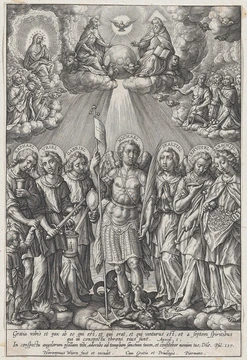
Hadraniel
Awe-inspiring angel and guide to Moses.

Hadraniel (from Hebrew, meaning "Majesty of God") is an angel in Jewish angelology, often described as a towering and awe-inspiring presence. According to tradition, when Moses arrived in heaven to receive the Torah, he was struck speechless at the sight of Hadraniel. The angel objected to Moses receiving the Torah, causing Moses to weep in fear. God then appeared, rebuked Hadraniel for the trouble, and the angel quickly changed his attitude, becoming a guide for Moses. This guidance proved valuable, as Zoharic legend states that when Hadraniel announces God's will, his voice carries through 200,000 firmaments. In Gnostic texts, Hadraniel is one of seven subordinates under Jehuel, the prince of fire.
- field
- Angelology
- known_for
- Guide to Moses; voice that penetrates 200,000 firmaments
- height
- Not specified in standard sources (the measurement of over sixty myriads of parasangs is associated with Sandalphon)
- affiliation
- Jewish Angelology; also appears in Gnosticism as a subordinate to Jehuel, prince of fire
Lore & Background
According to Jewish Angelology, Hadraniel is a towering and fearsome angel. When Moses arrived in heaven to obtain the Torah, he was speechless with awe at the sight of Hadraniel. Hadraniel initially opposed Moses receiving the Torah, causing Moses to weep in fear. This prompted God to appear and reprimand Hadraniel for causing problems, after which Hadraniel quickly decided to behave and acted as a guide for Moses.
Reader's Guide
Hadraniel's significance lies in his dual role as a fearsome gatekeeper and a helpful guide, illustrating the complex hierarchy of angelic beings in Jewish tradition. His encounter with Moses underscores the idea that even the most daunting celestial figures can be redirected by divine will. The Zoharic legend that his voice penetrates through 200,000 firmaments when proclaiming the will of the Lord emphasizes his power as a herald. Additionally, the Revelation of Moses states that with every word from his mouth go forth 12,000 flashes of lightning, further cementing his association with divine revelation and awe. In Gnosticism, he is reduced to a subordinate of Jehuel, prince of fire, showing his adaptability across different theological systems. His mention in the Zohar, where he speaks to Adam about the Book of the Angel Raziel, links him to secret knowledge, adding a layer of mystery to his legacy.
Did You Know?
- When Hadraniel proclaims the will of the Lord, his voice penetrates through 200,000 firmaments.
- In Gnosticism, Hadraniel is one of seven subordinates to Jehuel, prince of fire.
- The immense height of over sixty myriads of parasangs is traditionally associated with the angel Sandalphon, not Hadraniel.
Frequently Asked Questions
Who is Hadraniel?
Hadraniel is an angel of Jewish angelology whose Hebrew name translates to "Majesty of God." He is traditionally portrayed as a towering, awe-inspiring celestial being who serves as a guide to Moses.
What are Hadraniel's powers or role?
Hadraniel is best known as a guide to Moses during the heavenly reception of the Torah. According to Zoharic tradition, his voice is so immense that when he proclaims God's will, it resonates through 200,000 firmaments.
What is the story of Hadraniel and Moses?
When Moses ascended to heaven to receive the Torah, Hadraniel initially objected to the transfer, leaving Moses speechless and weeping in fear. God then rebuked the angel, after which Hadraniel changed his stance and became Moses's guide through the celestial realms.
Why is Hadraniel important in angelology?
Hadraniel embodies the overwhelming divine majesty that celestial beings radiate before the Almighty. His arc from reluctant objector to willing guide for Moses makes him a distinctive figure in Zoharic and broader Jewish angelological tradition.
Does Hadraniel appear outside Jewish tradition?
Yes, Hadraniel also features in Gnostic texts, where he is listed as a subordinate to Jehuel, the prince of fire. He is not a figure found in the standard Christian biblical canon but rather in Jewish mystical and Gnostic literature.
More in Angels in Christianity 1-24
Spotted an error? Know more?
This is a living reference — every entry is fact-audited, and reader corrections feed straight into our audit queue. Suggest an edit · See this site's audit record