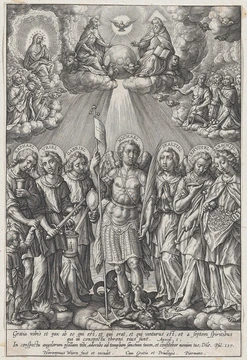
The Book of Azariah
Sunday lessons from a guardian angel based on pre-Vatican II Masses.

Sir Israel Gollancz · Public domain
The Book of Azariah is a work by the Italian author and Roman Catholic mystic Maria Valtorta, written in 1946 and 1947 while she was bedridden in Viareggio, Italy. The book presents a series of Sunday lessons attributed to a spirit named Azariah, whom Valtorta identifies as her guardian angel. The lessons take their starting points from the 58 Masses of the Roman Missal of the Catholic Church prior to the reforms of the Second Vatican Council in 1965.
- author
- Maria Valtorta
- nationality
- Italian
- field
- Roman Catholic mysticism
- written
- 1946–1947
- location
- Viareggio, Italy
- known_for
- A set of Sunday lessons attributed to her guardian angel Azariah
Lore & Background
Maria Valtorta, an Italian Roman Catholic mystic, wrote The Book of Azariah during 1946 and 1947 while confined to her bed in Viareggio, Italy, where she had been bedridden for several decades. The book does not provide a specific biblical reference to the figure Azariah; instead, Valtorta refers to the spirit simply as her guardian angel. The work consists of a set of lessons delivered on Sundays, each taking its starting point from one of the 58 Masses of the Roman Missal used before the Second Vatican Council reforms of 1965.
Reader's Guide
The Book of Azariah holds significance primarily within circles interested in Catholic mysticism and the writings of Maria Valtorta. Its structure—linking Sunday lessons to specific pre-Vatican II Masses—offers a devotional framework that reflects a particular moment in Catholic liturgical history. The work's claim to be dictated by a guardian angel places it in a tradition of private revelation, though it has not been formally endorsed by the Catholic Church. Its legacy is tied to Valtorta's broader corpus, especially her better-known work The Poem of the Man God, and it continues to be read by those seeking spiritual commentary rooted in traditional Catholic liturgy.
Did You Know?
- The book was written in 1946 and 1947 in Viareggio, Italy, while Valtorta was bedridden.
- Valtorta refers to Azariah as her guardian angel, not as a biblical figure.
- Each lesson takes its starting point from one of the 58 Masses of the pre-Vatican II Roman Missal.
- An example lesson from May 26, 1946, comments on the Gospel of John 16:23-30.
Authorship and the Seclusion of Composition
Maria Valtorta, an Italian writer whose work is deeply rooted in Roman Catholic mysticism, composed The Book of Azariah over the course of 1946 and 1947. The circumstances of its creation are remarkable: Valtorta was confined to her bed in Viareggio, a town on the Italian coast, where she had endured decades of prolonged physical immobility. Rather than being the product of active research, travel, or public engagement, the book emerged from long stretches of stillness and interior contemplation in a single room. It also arrived in the immediate aftermath of World War II, a period of profound upheaval across European religious and cultural life. Valtorta's dual identity as both a literary author and a mystic is essential to understanding the text. It is not a scholarly treatise or a devotional manual in the conventional sense; it is a record of spiritual instruction received in a state of physical limitation. The decades-long confinement in Viareggio lends the work a particular intimacy, as though the lessons were whispered into a silence that stretched for years.
Liturgical Architecture and the Sunday Cycle
The Book of Azariah is organized around a distinctly liturgical framework rather than a narrative arc or a systematic theological outline. The text takes the form of a series of lessons delivered by the spirit Azariah on Sundays, each one anchored to a specific point in the worship calendar. The starting points for these lessons are drawn from the 58 Masses of the Roman Missal as it stood before the liturgical reforms that followed the Second Vatican Council in 1965. This ties the book firmly to a pre-reform Catholic cycle of worship. A concrete example is the lesson dated May 26, 1946, which falls on the fifth Sunday after Easter and takes its proper Gospel from John 16:23-30. Azariah's reflections then unfold outward from that scriptural passage. By binding each Sunday's teaching to a fixed slot in the liturgical year, Valtorta creates a work that could, in principle, be read alongside the Mass cycle itself, serving as a companion meditation for every Sunday across the year.
The Guardian Angel's Voice and the Theology of Generosity
One of the book's most distinctive features is the identity—or deliberate ambiguity—of its speaker. Valtorta does not anchor Azariah to any named figure from Scripture. Instead, she identifies the spirit simply as her personal guardian angel, a celestial companion who imparts instruction in a singular, intimate register. This choice keeps the voice close and individual rather than situating it among the broader cast of named angels in the biblical tradition. The theological content of Azariah's lessons centers heavily on generosity as the governing principle of the soul's relationship with God. In the passage tied to the fifth Sunday after Easter, Azariah describes a dynamic of reciprocal giving: the soul offers itself to God, and God responds with even greater generosity. The spirits who observe from the heights of Heaven, guided by divine light, witness what Azariah calls the wonderful prodigies of this competition. The soul's rise or fall, Azariah explains, is directly tied to the degree of generosity with which it adheres to the Lord.
Publication Delay and Place in Valtorta's Literary World
The Book of Azariah was not made available to readers until 1972, roughly a quarter-century after Valtorta completed its composition in 1946 and 1947. This considerable gap between writing and publication suggests a period of private circulation or delayed editorial preparation before the text reached a wider audience. The 1972 edition carries the ISBN 88-7987-013-0. The book occupies a specific place within Valtorta's broader literary output, which also includes The Poem of the Man God, published in 1949. That earlier work, referenced with the same ISBN in the available citation, indicates a connected body of mystically oriented writing. The Book of Azariah, with its structured Sunday lessons and its guardian-angel narrator, represents a more systematically organized work compared to the poetic form suggested by the title of the 1949 volume. Together, these texts sketch the profile of an author whose creative life, though physically confined to a bed in Viareggio for decades, produced a sustained and thematically coherent body of Catholic mystical literature spanning from the late 1940s into the 1970s.
Gallery

Frequently Asked Questions
What is The Book of Azariah?
It is a collection of Sunday lessons presented as teachings from a guardian angel named Azariah, composed by Italian mystic Maria Valtorta. The work was written while she was bedridden in Viareggio, Italy, spanning 1946 and 1947.
Who is Azariah in The Book of Azariah?
Azariah is the spirit Valtorta identifies as her personal guardian angel, and he functions as the voice delivering each of the Sunday lessons throughout the book.
What are the lessons in The Book of Azariah based on?
Each lesson draws its starting point from one of the 58 Masses contained in the Roman Missal as it stood before the liturgical reforms of the Second Vatican Council in 1965.
When and where was The Book of Azariah written?
Maria Valtorta composed the text during 1946 and 1947 while confined to her bed in the coastal town of Viareggio, Italy.
Is The Book of Azariah part of the Catholic Bible?
No, it is not a canonical scripture but rather a work of Roman Catholic mysticism by a single author. It is a private spiritual text rooted in Valtorta's claimed angelic communication rather than in official Church doctrine.
More in Angels in Christianity 1-24
Spotted an error? Know more?
This is a living reference — every entry is fact-audited, and reader corrections feed straight into our audit queue. Suggest an edit · See this site's audit record