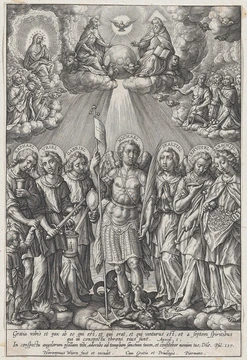
Jegudiel
Archangel of reward for the righteous and punishment for sinners.

Jegudiel (Hebrew: יְהוּדִיאֵל Yehudīʾēl, meaning "praise of God" or "God is my praise"), also referred to as Saint Iehudiel, is counted among the seven Archangels in Eastern Orthodox tradition. In iconography, he is typically shown standing upright, holding a crown in his right hand and a rod or staff in his left. The crown represents God’s reward for the righteous, while the three-thonged whip he sometimes carries symbolizes punishment for sinners.
As the patron of all who work in any field of endeavor, the crown he bears signifies the reward for successful spiritual labors. Together with his subordinate angels, he serves as advisor and defender for those in positions of responsibility who work for the glory of God—including kings, judges, and other leaders. Jegudiel is also known as the bearer of God’s merciful love. The name Jegudiel first appears in later medieval and Eastern Orthodox tradition, not in the Book of Enoch.
- name
- Jegudiel (Saint Iehudiel)
- tradition
- Eastern Orthodox
- symbols
- Crown and three-thonged whip (or rod/staff)
- patronage
- All who work in endeavor; kings, judges, and leaders
- known_for
- Bearer of God's merciful love
- first_mentioned
- Later medieval and Eastern Orthodox tradition
Lore & Background
Jegudiel is depicted in Eastern Orthodox iconography holding a crown and a three-thonged whip, representing God's reward for the righteous and punishment for sinners. The classic depiction shows him standing upright, with a crown in his right hand and a rod or staff in his left hand. He is the patron of all who work in some field of endeavor, and the crown symbolizes the reward for successful spiritual labors.
Reader's Guide
Jegudiel's significance lies in his role as the advisor and defender of those in positions of responsibility, such as kings, judges, and leaders, who work to the glory of God. Along with his subordinate angels, he supports those who labor in various fields. In a variant Catholic system, he is paired with Friday as one of the seven archangels associated with days of the week. His name first appears in the non-canonical Book of Enoch, dating between 130 BC and 68 AD, marking an early reference to his existence in angelological traditions. His legacy endures in Eastern Orthodox and some Catholic devotional practices, including chaplets dedicated to him.
Did You Know?
- Jegudiel is also known as Saint Iehudiel.
- He is one of the seven Archangels in the Eastern Orthodox tradition.
- His name means 'praise of God' or 'God is my praise' in Hebrew.
- His name first appears in later medieval and Eastern Orthodox tradition, not in the Book of Enoch.
Frequently Asked Questions
Who is Jegudiel?
Jegudiel, also called Saint Iehudiel, is one of the seven Archangels recognized in Eastern Orthodox tradition. He is regarded as the bearer of God's merciful love and the angel who administers both reward to the righteous and punishment to sinners.
What symbols are associated with Jegudiel in iconography?
In Orthodox icons, Jegudiel is shown standing upright, holding a crown in his right hand and a rod or staff in his left. The crown represents the divine reward given to the faithful, while the three-thonged whip he sometimes carries symbolizes the punishment reserved for sinners.
What is Jegudiel's patronage or role?
Jegudiel serves as the patron angel for all who labor in any field of endeavor, as well as for kings, judges, and leaders. His crown underscores the idea that faithful spiritual work is ultimately rewarded by God.
In which Christian tradition is Jegudiel recognized?
Jegudiel is specifically counted among the seven Archangels in Eastern Orthodox tradition, and his name first appears in later medieval and Orthodox sources rather than in the canonical Bible.
What does the name Jegudiel mean?
The name derives from the Hebrew Yehudīʾēl, which translates to 'praise of God' or 'God is my praise.' This etymology mirrors his role as the angel who bestows God's praise and reward upon the faithful.
More in Angels in Christianity 1-24
Spotted an error? Know more?
This is a living reference — every entry is fact-audited, and reader corrections feed straight into our audit queue. Suggest an edit · See this site's audit record