John 1:51
Final verse of John chapter 1, referencing Jacob's ladder.

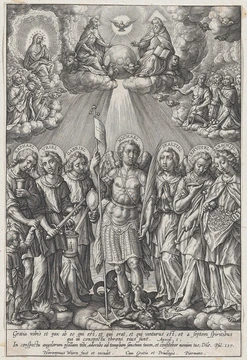
John 1:51 is the 51st and final verse in the first chapter of the Gospel of John in the New Testament. In it, Jesus speaks to Nathanael, beginning with the emphatic double affirmation "Amen, amen" to underscore the importance of his statement. He promises that Nathanael and others will see the heavens opened and the angels of God ascending and descending upon the Son of Man. The verse appears in the original Greek as recorded in the Westcott-Hort text, and translations such as the King James Version and the New International Version render it with similar wording. Commentators have offered various interpretations. Irish Archbishop John McEvilly noted that the repeated "Amen" signals the weight of the coming declaration and suggested that Jesus used the title "Son of Man" rather than "Son of God" out of humility. Scholars have debated when the promised vision occurs: possibilities include Jesus' agony in Gethsemane (when an angel strengthened him), his baptism (when a dove descended), his ascension (when angels accompanied him), or the future Day of Judgment. The Church Fathers also drew connections to the Old Testament. Augustine linked the verse to Jacob's dream of a ladder with angels ascending and descending, interpreting the ladder as a symbol of Christ, who is both above and below. He also suggested that good preachers who proclaim Christ act as angels, ascending and descending upon the Son of Man, citing Paul as an example. Augustine further speculated that Nathanael, despite receiving such praise from Jesus, may not have been among the twelve apostles because of his learning and legal expertise, noting that Jesus often chose the unlearned to confound the proud.
- field
- Biblical verse
- known_for
- Last verse of John chapter 1; reference to Jacob's ladder and angels ascending and descending on the Son of Man
Lore & Background
In the original Greek according to Westcott-Hort, the verse reads: 'Καὶ λέγει αὐτῷ, Ἀμὴν ἀμὴν λέγω ὑμῖν, ἀπ᾿ ἄρτι ὄψεσθε τὸν οὐρανὸν ἀνεῳγότα, καὶ τοὺς ἀγγέλους τοῦ Θεοῦ ἀναβαίνοντας καὶ καταβαίνοντας ἐπὶ τὸν υἱὸν τοῦ ἀνθρώπου.' The King James Version translates it as: 'And he saith unto him, Verily, verily, I say unto you, Hereafter ye shall see heaven open, and the angels of God ascending and descending upon the Son of man.' The New International Version renders it: 'He then added, "I tell you the truth, you shall see heaven open, and the angels of God ascending and descending on the Son of Man."'
Irish Archbishop John McEvilly believed that the double 'Amen' points to the importance of what follows, and that Jesus used 'Son of man' out of humility. The larger question is when the opening of heaven occurs. Lapide enumerated several possibilities: at Christ's agony in Gethsemane when an angel strengthened Him; at His baptism when a dove formed by angels descended; at His ascension when angels accompanied Him; or at the Day of Judgment when all angels will stand before Him.
Reader's Guide
John 1:51 is significant for its connection to Jacob's ladder in Genesis 28:12, as noted by Augustine. Augustine interpreted the angels ascending and descending upon the Son of Man as representing good preachers who preach Christ, ascending to heaven and descending to minister to others, like Paul who ascended to the third heaven and descended to give milk to babes. Augustine also questioned why Nathanael, to whom Jesus bore such testimony, was not among the twelve Apostles, suggesting it may have been because he was learned and versed in the law, while Jesus chose the foolish to confound the world. The verse's ambiguity about when the vision occurs—whether at historical events in Jesus' life or at the end of time—has led to diverse interpretations among commentators, preserving the mystery of the text.
Did You Know?
- John 1:51 is the last verse in the first chapter of the Gospel of John.
- The verse uses the phrase 'Amen, amen,' which Irish Archbishop John McEvilly believed points to the importance of what follows.
- Lapide listed four possible times for the opening of heaven: Christ's agony in Gethsemane, His baptism, His ascension, or the Day of Judgment.
- Augustine connected this verse to Jacob's ladder in Genesis 28:12.
More in Angels in Christianity 1-24
Spotted an error? Know more?
This is a living reference — every entry is fact-audited, and reader corrections feed straight into our audit queue. Suggest an edit · See this site's audit record