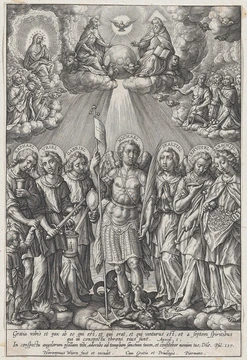
John 20:12
Mary Magdalene sees two angels at Jesus' empty tomb.

John 20:12 is the twelfth verse of the twentieth chapter of the Gospel of John in the New Testament. Here, Mary Magdalene looks inside Jesus’ empty tomb and sees two angels. In the King James Version, the verse reads: “And seeth two angels in white sitting, the one at the head, and the other at the feet, where the body of Jesus had lain.” The English Standard Version renders it: “And she saw two angels in white, sitting where the body of Jesus had lain, one at the head and one at the feet.”
This account differs from the other gospels. Matthew 28:2-7 mentions only one angel, while Mark 16 describes a young man (presumably an angel) sitting on the right side. In Luke’s account, two men (identified as angels in Luke 24:23) appear standing near the women. Those who hold to biblical inerrancy explain these variations by suggesting Mary made multiple trips to the tomb. This is the only instance in the Gospel of John where angels appear. Rationalist critics argue the angels were never present and were later added to the story. Rudolf Schnackenburg contends they were a later insertion meant to strengthen the evidence that Jesus’ body was gone; by placing the angels at the head and foot, the narrative implies a thorough examination of the spot, which also explains why the angels are quickly forgotten later in the chapter.
Some writers connect the two angels to the pair that guarded the Ark of the Covenant. Johann Jakob Wettstein proposed a link between the angels and the two criminals crucified alongside Jesus. The angels wear the standard biblical attire of white or radiant clothing, though the text does not clarify whether they appeared as ordinary men (whom Mary might not have recognized as angels) or as the radiant beings often described. Their seated position suggests Jesus’ body lay on a raised shelf or ledge, consistent with the rest of John’s gospel. However, early pilgrims to the tomb reported a trough-like burial. F. F. Bruce argued that a trough is possible, since angels would not need the same material support as humans. Some scholars think the clear distinction between head and foot indicates a tomb with a built-in headrest; others believe it simply refers to the direction Jesus was placed. A further question is why the angels did not appear to the disciples when they examined the tomb. Brooke Foss Westcott explained this by stating that “such manifest
- book
- Gospel of John
- chapter
- 20
- verse
- 12
- subject
- Mary Magdalene sees two angels at Jesus' tomb
- key detail
- Angels sitting where Jesus' body had lain, one at the head and one at the feet
Lore & Background
The angels' sitting position implies Jesus' body was on a raised shelf or ledge, consistent with the Gospel. However, early pilgrims reported a trough tomb. F. F. Bruce argues angels would not require material support. Some scholars believe the head-foot distinction indicates a built-in headrest; others think it refers to the direction Jesus was placed. Brooke Foss Westcott explains the angels' absence from the disciples by saying such manifestations follow spiritual laws.
Reader's Guide
John 20:12 is significant as the sole appearance of angels in the Gospel of John, marking a key moment in the resurrection narrative. The verse highlights Mary Magdalene's role as the first witness to the empty tomb and the angelic testimony. The angels' position—at the head and feet—emphasizes the physical absence of Jesus' body, reinforcing the resurrection claim. The verse also invites comparison with other gospel accounts, illustrating the diversity of early Christian traditions. Scholarly debates about the angels' historicity, attire, and the tomb's structure reflect broader questions about the development of the resurrection story. The verse's placement within John's Gospel, where angels are otherwise absent, underscores its thematic importance in validating the empty tomb. The angels' quick disappearance later in the chapter, as noted by Schnackenburg, suggests their narrative function was to confirm the body's absence rather than to play a sustained role. Overall, John 20:12 contributes to the theological and historical layers of the resurrection account, prompting ongoing discussion among believers and critics alike.
Did You Know?
- This is the only time in the Gospel of John that angels appear.
- Rudolf Schnackenburg argues the angels were a later addition to reinforce evidence that Jesus' body was gone.
- Some writers link the two angels to the pair who guarded the Ark of the Covenant.
- The text does not clarify if the angels appeared as normal men or radiant beings.
More in Angels in Christianity 1-24
Spotted an error? Know more?
This is a living reference — every entry is fact-audited, and reader corrections feed straight into our audit queue. Suggest an edit · See this site's audit record