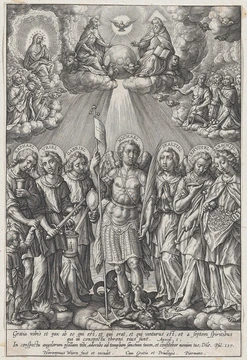
Lower than the angels
A phrase from Psalm 8:5 and Hebrews 2:7 sparking Christological debate.

The phrase 'Lower than the angels' originates from Psalm 8:5 and is cited in Hebrews 2:7 of the New Testament. It has been a frequent locus of Christological controversy throughout the history of Christianity and theology, centering on whether the original Hebrew text ('lower than God') or the Greek Septuagint translation ('lower than the angels') should govern interpretation.
- associated_works
- Tertullian's Adversus Praxean; Erasmus's published reasons
Lore & Background
The phrase is drawn from Psalm 8:5, but the author of Hebrews follows the Greek of the Septuagint with the reading 'lower than the angels' (Hebrews 2:7) instead of the Hebrew 'lower than God' (Elohim). The original Hebrew text is usually construed as 'you made him [man] lower than God', while the Septuagint has the meaning 'you made him [man] lower than the angels'.
The passage occupies a central place in Tertullian's Adversus Praxean. It was also the subject of a notable exegetical dispute between Erasmus and Jacques Lefèvre d'Étaples. Lefèvre argued that the passage in Hebrews, although it clearly says 'angels' in the Greek, should still be understood according to the original source in the Hebrew text with 'lower than God', while Erasmus argued that exegesis of Hebrews 2 should follow the Septuagint of Psalm 8:5. Erasmus took the controversy to the extent of publishing multiple reasons why his interpretation was to be preferred, though the exact number is not historically recorded as seventy-two. Despite the disagreement, the two scholars remained in correspondence and eventually reconciled.
Reader's Guide
The phrase 'Lower than the angels' has been a persistent point of Christological controversy, as it touches on the nature of Christ's incarnation and his relationship to both God and angels. The divergence between the Hebrew text of Psalm 8:5 ('lower than God') and the Greek Septuagint translation used in Hebrews 2:7 ('lower than the angels') created a fundamental exegetical tension. Tertullian's use of the passage in Adversus Praxean shows its early importance in Trinitarian debates. The later dispute between Erasmus and Jacques Lefèvre d'Étaples exemplifies how this textual variation could fracture scholarly friendships and drive extensive argumentation—Erasmus produced seventy-two reasons for his position. The controversy remains unresolved in the sense that the article notes both readings and the dispute, without settling which is correct. This phrase thus serves as a case study in how translation choices affect theological interpretation, particularly regarding Christ's status and the relationship between Old and New Testament texts.
Did You Know?
- The phrase is drawn from Psalm 8:5, but the author of Hebrews follows the Greek Septuagint reading 'lower than the angels' instead of the Hebrew 'lower than God'.
- The passage occupies a central place in Tertullian's Adversus Praxean.
- The phrase was the subject of a notable exegetical dispute between Erasmus and Jacques Lefèvre d'Étaples, though they remained in correspondence and eventually reconciled.
- Erasmus published multiple reasons why his interpretation of the passage was to be preferred, though the exact number is not historically recorded as seventy-two.
More in Angels in Christianity 1-24
Spotted an error? Know more?
This is a living reference — every entry is fact-audited, and reader corrections feed straight into our audit queue. Suggest an edit · See this site's audit record