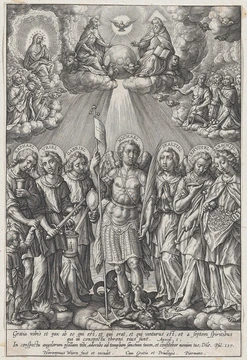
Matthew 28:3
Verse depicting the angel at Jesus' tomb.

Matthew 28:3 is the third verse in the twenty-eighth chapter of the Gospel of Matthew. It belongs to the resurrection story and depicts the angel that came to Jesus' tomb in the preceding verse.
In the original Koine Greek (as established by Westcott and Hort), the verse reads: "ην δε η ειδεα αυτου ως αστραπη και το ενδυμα αυτου λευκον ως χιων." The King James Version renders this as "His countenance was like lightning, and his raiment white as snow," while the World English Bible translates it as "His appearance was bright as lightning, and his clothing is white as snow."
This verse underscores the significance of the figure and the events from the previous verse, presenting the angel as an exalted being. The other gospels offer more subdued descriptions: Mark 16:5 and John 20:12 mention a figure in white, and Luke 24:4 (in the Revised Standard Version and some other translations) describes the clothes as "dazzling," which may combine the lightning-like face and white garments seen here.
The angel's depiction echoes several Old Testament passages, reflecting Matthew's tendency to reference scripture. Daniel 10:6 describes an angel with a face like lightning, and Ezekiel 1 associates lightning with the creatures around God. Daniel 7:9 portrays God himself as white as snow. This suggests angels are linked to God and serve a theophanic role beyond mere messengers.
The description also resembles the transfigured Christ in Matthew 17:2, though Boring notes the angel in this verse is slightly less glorious than Jesus, highlighting Jesus' more divine nature. Jesus is similarly described as white as snow in Revelation 1:14. The color white symbolizes purity in both Testaments, reflecting the cultural norms of the time, when Jewish rabbis, Egyptian priests, and pious worshippers commonly wore white.
Several early manuscripts contain this verse, including Codex Vaticanus (~325-350), Codex Sinaiticus (~330-360), Codex Bezae (~400), Codex Washingtonianus (~400), Codex Alexandrinus (~400-440), Codex Ephraemi Rescriptus (~450), Papyrus 105 (5th/6th century), and Codex Purpureus Rossanensis (6th century).
- field
- Biblical verse
- known_for
- Describing the angel at Jesus' tomb with appearance like lightning and clothing white as snow
Lore & Background
The original Koine Greek, according to Westcott and Hort, reads: ην δε η ειδεα αυτου ως αστραπη και το ενδυμα αυτου λευκον ως χιων. In the King James Version it is translated as: 'His countenance was like lightning, and his raiment white as snow.' The modern World English Bible translates the passage as: 'His appearance was bright as lightning, and his clothing is white as snow.'
Reader's Guide
As with the great events of the previous verse, this verse emphasizes the importance of the figure and the events that happened. The text depicts the angel as an exalted figure and thus prompting great importance. The other gospels have a more muted description of the angel: Mark 16:5 and John 20:12 refer to a figure clad in white, while Luke 24:4 in the Revised Standard Version and some other translations describes the clothes as 'dazzling', perhaps combining the lightning face and white clothes of this verse. The image of the angel has multiple descriptions in the Old Testament, reflecting Matthew's fondness for scriptural references. Daniel 10:6 mentioned an angel with a face like lightning, and Ezekiel 1 since lightning associates with the creatures surrounding God. Daniel 7:9 described God himself as appearing white as snow. This suggests that angels are linked to God and that they are more than mere messengers, but they also play an important theophonic role. The description is also similar to that of the transfigured Christ at Matthew 17:2, but Boring suggests that the angel in that verse was a bit less in glory from Jesus, showing his more divine nature. Jesus is also described as being white as snow in Revelation 1:14. The color white symbolizes purity in both the Old and New Testaments, a reflection of the culture in that period. Jewish rabbis, Egyptian priests, and pious worshippers were all normally clad in white in this period.
Did You Know?
- The verse is part of the resurrection narrative and describes the angel who arrived at the tomb of Jesus.
- Some early manuscripts containing the text include Codex Vaticanus (~325-350) and Codex Sinaiticus (~330-360).
- The description of the angel is similar to that of the transfigured Christ at Matthew 17:2.
- The color white symbolizes purity in both the Old and New Testaments.
More in Angels in Christianity 1-24
Spotted an error? Know more?
This is a living reference — every entry is fact-audited, and reader corrections feed straight into our audit queue. Suggest an edit · See this site's audit record