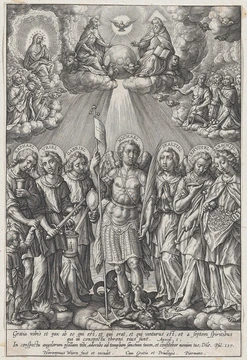
Matthew 4:6
The devil tempts Jesus to throw himself from the temple.

Matthew 4:6 is the sixth verse of the fourth chapter of the Gospel of Matthew in the New Testament. After Jesus has rejected the first temptation, the devil offers a second one while they stand on the pinnacle of the temple in the "holy city" of Jerusalem.
In the King James Version, the devil says: "And saith unto him, If thou be the Son of God, cast thyself down: for it is written, He shall give his angels charge concerning thee: and in their hands they shall bear thee up, lest at any time thou dash thy foot against a stone." The World English Bible renders it: "and said to him, 'If you are the Son of God, throw yourself down, for it is written, "He will put his angels in charge of you." and, "On their hands they will bear you up, so that you don’t dash your foot against a stone."'" The 1881 Westcott-Hort Greek text reads: και λεγει αυτω ει υιος ει του θεου βαλε σεαυτον κατω γεγραπται γαρ οτι τοις αγγελοις αυτου εντελειται περι σου και επι χειρων αρουσιν σε μηποτε προσκοψης προς λιθον τον ποδα σου.
As with Matthew 4:3, the devil is not doubting Jesus' identity as the Son of God but is urging him to act on that identity. Here, the devil tries to convince Jesus to throw himself from the temple pinnacle because God has promised protection. To support this, the devil quotes scripture—an escalation, according to Swiss theologian Eduard Schweizer, over the first temptation. The quoted verses come from Psalm 91:11–12, which in the King James Version read: "For he will command his angels concerning you to guard you in all your ways; they will lift you up in their hands, so that you will not strike your foot against a stone." The quotation omits the line "to guard you in all your ways." Robert Gundry notes that the original wording indicates God promises protection only from accidents, not from deliberate acts like the one the devil proposes.
The specific evil the devil intends is debated. The traditional view sees the temptation narrative as rejecting sin, with this test luring Jesus toward hubris. Most modern scholars reject that view. Another interpretation holds that each temptation represents Jesus rejecting a particular vision of the Messiah; here, the devil tries to convince him to be a miracle worker who wins converts through spectacular acts. Gundry points out that the temple setting supports this, as many precipices exist in the wilderness, but bringing
- book
- Gospel of Matthew
- chapter
- 4
- verse
- 6
- speaker
- the devil (the tempter)
- setting
- pinnacle of the temple in Jerusalem
- quoted scripture
- Psalm 91:11-12
Lore & Background
In the King James Version, the devil says, 'If thou be the Son of God, cast thyself down: for it is written, He shall give his angels charge concerning thee: and in their hands they shall bear thee up, lest at any time thou dash thy foot against a stone.' The World English Bible renders it similarly. The 1881 Westcott-Hort Greek text provides the original language. The devil quotes Psalm 91:11-12, but omits the line 'to guard you in all your ways,' which Robert Gundry notes makes clear the promise is about accidents, not deliberate acts.
Reader's Guide
Commentary on this verse notes that, as with Matthew 4:3, Satan is not doubting Jesus is the Son of God but is urging him to act because he is. The devil's use of scripture is seen by Eduard Schweizer as an escalation over the first temptation. The exact evil intended is debated: traditional views saw it as luring Jesus into hubris; a later view held that Satan wanted Jesus to become a miracle worker; a current view is that Satan proposed testing God, as the Israelites did after the Exodus. Church Fathers such as Jerome, Pseudo-Chrysostom, Ambrose, and Chrysostom offer varied interpretations, with Jerome noting the devil misapplies scripture and Chrysostom observing that the devil omits the part about treading on the asp and basilisk.
Did You Know?
- The verse is the second temptation of Jesus in the Gospel of Matthew.
- Satan quotes Psalm 91:11-12 but omits the line 'to guard you in all your ways.'
- The setting is the pinnacle of the temple in Jerusalem, called the 'holy city.'
- The 1881 Westcott-Hort Greek text provides the original Greek wording of the verse.
More in Angels in Christianity 1-24
Spotted an error? Know more?
This is a living reference — every entry is fact-audited, and reader corrections feed straight into our audit queue. Suggest an edit · See this site's audit record